Recipes & Videos

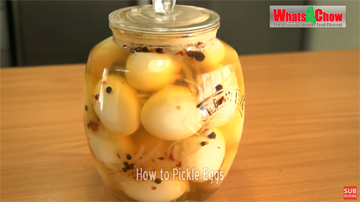
How to Pickle Eggs – Perfect Spicy Pickled Eggs Recipe – Bar Style – Pub Style Pickled Eggs

How to Pickle Eggs


How to Pickle Eggs - Perfect Spicy Pickled Eggs Recipe - Bar Style - Pub Style Pickled Eggs
Author: 
Recipe type: Eggs
Serves: 30
 
In today’s episode we’re going to make spicy pickled eggs. These Easy Pickled Eggs are a delicious and healthy snack that everyone will enjoy! They make an amazing snack, make egg salads a breeze, and look awesome on a charcuterie board.
Ingredients
  • 1500ml White vinegar
  • 500ml Water
  • 10ml Himalayan rock salt
  • 2 Large onions
  • 3 Bay leaves
  • ⅔ Cup caster sugar
  • 5 Allspice / pimento berries
  • 1Tbs Black peppercorns
  • 1Tbs Dried chilli flakes
  • 30 Eggs
Instructions
  1. In today’s episode we’re going to make spicy pickled eggs.
  2. These Easy Pickled Eggs are a delicious and healthy snack that
  3. everyone will enjoy! They make an amazing snack, make egg
  4. salads a breeze, and look awesome on a charcuterie board.
  5. In addition to this, it is a safe and practical way to preserve your
  6. eggs if you have more than you can use immediately… let’s get
  7. started.
  8. Take 30 eggs and use a needle to prick the flat end of each egg.
  9. This will allow the air-pocket to escape when the contents of
  10. the egg expand under heat. This helps prevent the shells from
  11. cracking, and gives a better formed egg once boiled. It will not
  12. totally negate the deformation of the base of the egg, but it
  13. certainly does help.
  14. Place all of the eggs in a large pot and cover them with cold
  15. water. Heat the pot over high heat until boiling, then start your
  16. timer. You want the eggs to boil for 10 minutes. Use a slotted
  17. spoon to give them gentle stir once every few minutes. This will
  18. ensure even cooking.
  19. After 10 minutes, transfer the eggs to a large bowl filled with ice
  20. cold water. Allow the eggs to stand for 30 minutes to cool
  21. completely.
  22. While the eggs cool, let’s start with the pickling brine. Slice 2
  23. large onions thinly and add them to a medium size pot, along
  24. with 2 teaspoons of Himalayan rock salt, a tablespoon of dried
  25. chilli flakes, a tablespoon of black peppercorns, 3 bay leaves, 5
  26. all-spice or pimento berries, 2 thirds of a cup of caster sugar,
  27. ml water, and 1500ml white vinegar.
  28. Heat this all until boiling, then reduce the heat and simmer the
  29. mixture for 5 minutes, then remove it from the heat.
  30. By stage the eggs have cooled and it’s time to peel them. Tap
  31. the shells around the circumference of the egg on your work
  32. surface to crack them. Peel away a little of the shell, grab the
  33. membrane and pull on this. The membrane will literally pull the
  34. shell away from the egg.
  35. Pack a layer of eggs into a large pickling jar and top this with
  36. some of the onion and spices. Pack another of eggs on top of
  37. this and continue in this fashion until all the eggs are packed.
  38. Pour the pickling brine over the eggs until it is covering the eggs
  39. completely. Put the lid on the container and allow it all to cool
  40. completely.
  41. Once cooled, transfer the eggs to your refrigerator for at least 7
  42. days before enjoying your delicious pickled eggs. This gives the
  43. brine and spices a chance to really permeate the eggs making
  44. for a memorable meal.
  45. The eggs will last for months under refrigeration.
  46. That’s it for today folks, please like, subscribe and share, and
  47. we’ll see you again real soon.


How to hard Boil Ostrich Eggs – How to Sous Vide Ostrich Eggs – @Whats4Chow


How to hard Boil Ostrich Eggs - How to Sous Vide Ostrich Eggs - @Whats4Chow
Author: 
Recipe type: Eggs
Serves: 2
 
Today we’re going to hard boil an ostrich egg, and at the same time, we’re going to sous vide another ostrich egg in my big digital pot.
Ingredients
  • Ostrich Eggs
  • Vinegar
  • Water
Instructions
  1. How to Hard Boil Ostrich Eggs – How to Sous Vide Ostrich Eggs - @Whats4Chow
  2. Hi and welcome to episode #641 with Whats4Chow.com.
  3. Today we’re going to hard boil an ostrich egg, and at the same
  4. time, we’re going to sous vide another ostrich egg in my big
  5. digital pot. Before I started on this journey, I searched the
  6. internet to see what information was available on both
  7. methods, and only found a little info on boiling the eggs. The
  8. consensus for boiling seems to be 90-120 minutes.
  9. As far as sous vide goes, there is absolutely nothing on the web,
  10. so I did some calculations of my own, based on how I’d sous
  11. vide a thick chunk of meat similar in weight and size to the egg.
  12. The closest I came was a large pork knuckle of 1.8kg and roughly
  13. the same size as the egg. I have done hundreds of those very
  14. successfully, and the timing / temperature combination for
  15. those was 13 hours at 73c --- so that was my starting point.
  16. I also added a cup full of vinegar to each pot in the hope that
  17. the vinegar would weaken the shell a little and make it easier to
  18. peel after the cooking process was complete.
  19. I brought a large pot of water vinegar solution to a boil and
  20. placed the egg in the water, set my timer for 2 hours and
  21. carried on preparing the sous vide pot. You may have noticed
  22. that the egg was floating. This is never a good sign with any egg,
  23. as it means the egg is near or past it’s sell-by date. It was too
  24. late to turn back, so I continued.
  25. Here I raised the temperature to 73c and placed in the egg in
  26. the pot. I put the lid on and set my timer for 13 hours.
  27. After 2 hours, I removed the egg in the boiling pot from the
  28. water and immediately plunged it into a large bowl of iced
  29. water. This halts the cooking process, and also helps loosen the
  30. membrane that sits between the shell and the egg. I let this cool
  31. for 60 minutes, and proceeded to peel the egg.
  32. I did this by chipping a line into the shell using my butcher’s axe,
  33. but you could use anything like this, including the back of a
  34. cleaver or heavy blade knife.
  35. As I suspected, the egg was off…. Rotten, and half of the egg’s
  36. mass had already wasted through the porous shell. At least it
  37. allowed me to practice the peeling part of the exercise.
  38. And, despite this all, the egg appeared to be properly hard
  39. boiled, with a firm white, or in this case brown, and firm yolk.
  40. Another 11 hours later,
  41. I removed the sous vide egg from the cooker and plunged this
  42. into a bowl of iced water. Once again I left this for 60 minutes to
  43. cool. I noticed immediately that the vinegar in the water had
  44. almost totally softened the outler layer of once shiny enamel on
  45. the shell, and this could simply be rubbed off.
  46. I chipped a line into the shell and started to peel it away. This
  47. egg did not float at all, but did have a pronounced air sac at the
  48. bottom end, indicating that it was pretty close to it’s sell-by
  49. date. An interesting point to note is just how thick the
  50. membrane is.
  51. I cut through the egg and found that the sous vide time was just
  52. short. The white of the egg had not set entirely, and there was a
  53. small under-cooked patch in the centre of the yolk.
  54. On the second day, I ran out to our local ostrich farm and
  55. grabbed another 2 eggs, this making sure they had just been
  56. laid.
  57. The first egg was processed exactly the same as the boiled egg,
  58. but the sous vide egg I adjusted the process to counter the
  59. under-cooked result in the first test. I decided to increase the
  60. sous vide temperature instead of increasing the time. I
  61. increased the temperature to 80c for 13 hours, and everything
  62. worked out just fine.
  63. The boiled egg was disappointing in appearance, with the white
  64. having a dull grey color, however the sous vide ostrich egg was
  65. much better, with a more pleasing color and better texture.
  66. It is important to note that if you want a nice clean cut through
  67. the yolk, you will need to use a wire cutter, not a blade.
  68. Here is a little serving suggestion I put together – sliced ostrich
  69. egg served with crispy bacon, sausage, tomato and mustard
  70. mayo sauce.


How to Dry Onions & Make Onion Powder @Whats4Chow

How to Dry Onions


How to Dry Onions & Make Onion Powder @Whats4Chow
Author: 
Recipe type: Preserving / Vegetable
 
In today's episode, we're going to be drying or dessicating onions. This is a fantastic way to preserve your onions, and I find that dried onion flakes and onion powder lend a different type of onion flavor to your meals - it is more of a roasted onion flavor as apposed to a regular onion flavor.
Ingredients
  • 2kg / 4.4lb Onions
  • 1-3 Tbs Cornstarch
  • Boiling Water
Instructions
  1. To start, top, tail, and peel your onions. You can use any cultivar of onion - these are California Brown. Cut the onions into quarters from top to bottom. This is much quicker and easier than chopping the onion, and you lose less volatile oils, and this is where all the flavor is. You will also find that the larger flakes will dry quicker and more evenly than smaller chopped bits that tend to clump together inhibiting the airflow in your dryer.
  2. Place all of the cut onion into a larger non-reactive bowl and cover them with boiling water. Allow this to stand for 3 minutes stirring constantly. This heat softens the membranes between the onion layers and will make the onion layers very easy to separate. This also dilutes some of the acidity resulting in a very mild aroma while drying. This is a major consideration if you're running your food dryer in the house, or worse, in an apartment.
  3. Drain the onions in a large colander, and start packing the onion into your food dryer trays, making sure to separate any layers that did not separate during the heating and stirring process. By placing some of the pieces facing up and others facing down, you will ensure a good airflow through the dryer as a result of the big gaps between the pieces.
  4. Once you're finished packing the onion into the trays, place the lid on top, make sure the lid vents are open and switch on the dryer.
  5. The process can take anywhere from 36 to 72 hours depending on the relative humidity, the moisture content of the onions in the beginning, and mostly, your machine. If you're using a small domestic dryer like this one, then it will take longer. In a larger semi-industrial unit like an Excalibur, it will be much quicker.
  6. This is the result after 3 days, or 72 hours. The onion is bone-dry, and simply crushes into pieces. At this stage, if you want onion flakes, crush them by hand to the size you require, and store. Alternatively, pulse them a few times in your food processor until the desired texture is achieved.
  7. I am going mill my dried onion in my spice grinder to get a fine powder. To do this, place a large handful of the onion into the grinder and zap it a few times to break it down. Add more onion and continue. By adding more and more onion, the grinder blades get the required back-pressure to do their job properly. Continue until the mill is full of powder, empty the machine, and continue with the remaining onion.
  8. As soon as the onion powder comes into contact with the atmosphere it starts to clump, or cake. To prevent this during storage, add 1-3 tablespoons of corn starch to the onion powder and mix it in.
  9. Store the powder in an airtight bottle in a cool place. It will last indefinitely under these conditions.


Molasses and Condensed Milk Fudge Recipe -Unique, Creamy and Smooth Fudge Recipe!

Molasses and Condensed Milk Fudge Recipe LR


Molasses and Condensed Milk Fudge Recipe -Unique, Creamy and Smooth Fudge Recipe!
Author: 
Recipe type: Confectionery
Cuisine: Universal
Serves: 30
 
In today's episode, we will be making a batch of smooth, creamy fudge. This fudge is like no other fudge, it is flavored with black strap molasses, giving it a deep rich flavor and aroma, second to none!
Ingredients
  • 1 380g Tin of sweetened condensed milk
  • 100ml Full cream milk
  • 400g Brown sugar
  • 115g Butter
  • 50g Blackstrap molasses
Instructions
  1. To start, you will need a medium size pot, a wood spoon or spatula, a baking sheet, 2 pieces of baking parchment, a rolling pin, and a candy or infrared thermometer.
  2. for the ingredients you will need a can of sweetened condensed milk, 400g of brown sugar, 115g of butter, 50g of black strap molasses and 100ml of full cream milk.
  3. Place all of the ingredients in the pot over medium high heat and stir until the sugar has dissolved. Bring the pot to a boil, and continue stirring constantly until the ingredients reach a temperature of 113 - 115c or 235-239f. This will take 10-15 minutes.
  4. At this point, remove the pot from the heat and allow it to cool for 5 minutes.
  5. After 5 minutes, start beating the mixture with the wooden spoon. Continue beating for 5-10 minutes until the mixture has lost its shine, and it just starts to come away from the sides and bottom of the pot. If you carry beating any longer, the fudge will end up grainy and crumbly.
  6. Pour the mixture into the lined baking sheet. Cover the mixture with the second piece of parchment, and use your rolling pin to roll the mixture into an even sheet, using the sides of the baking sheet as guides.
  7. Leave this to cool to about 35c or 95f. Use a ruler and a thin blade knife to slice the fudge into neat squares. Allow to cool completely before serving and enjoying.
  8. That's it for today folks, please like, subscribe and share, and we'll see again real soon.
  9. Please subscribe to our channel to receive notifications and updates!


How to Make Icelandic Skyr – Mad Millie’s Icelandic Skyr Kit – Quick and Easy!

Mad Millie's Icelandic Skyr Kit - How to Make Skyr Cream Cheese


How to Make Icelandic Skyr - Mad Millie's Icelandic Skyr Kit - Quick and Easy!
Author: 
Recipe type: Cheese
Cuisine: Icelandic
 
It has been some time since we did the unboxing of the Mad Millie range of Do-it-Yourself cheese, yogurt and chocoloate kits, and today we're going to use the Icelandic Skyr kit to make a batch of this delicious soft cheese.

Technically it is recognized as a cheese, but practically it is more akin to yogurt, but with the same nutritional value of a soft cheese. You can make it thick and creamy by using 2% low fat milk, or full cream milk. Today, we’re going to be using the full cream option, or 4% Let’s do a quick recap of what’s in the box…. a full color instruction booklet a one liter glass jar… the other ingredients and equipment are packed inside the jar….

this includes a dairy thermometer with a protective sleeve

the yogurt culture

a large piece of muslin cloth

and a blister pack of rennet tablets

To make a 1 liter batch of Skyr, you will need a sachet of the yoghurt culture and a half tablet of rennet. You will also need to supply a liter of full cream or low fat milk.

To start, dissolve the half tablet of rennet in 30ml of non-chlorinated water.

Pour your milk into the glass jar and heat it in your microwave oven until it reaches 40c or 105f. It is best to do this in short bursts, stirring and checking the temperature after each microwave cycle.

Once you have reached the desired temperature, add the culture, give it a stir, then add the rennet, making sure to stir the rennet again before adding it to the milk. Give it all one final stir to make sure everything is well distributed. Put the lid on the jar and let this stand overnight in a warm place. If you’re in the middle of winter, wrap the jar in a towel, or place it near the heat exchange on your refrigerator.

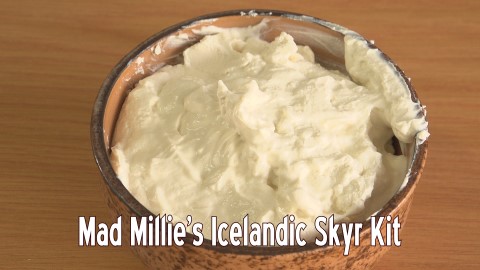
The following day, this is what you will have… a smooth, creamy yogurt. Place a colander over a bowl and line it with a double layer of the muslin cloth. Pour the Skyr into the muslin and let this drain for anything from 2 to 6 hours, depending on the consistency you want. The longer you drain the cheese, the thicker it will get. I am going to unwrap my batch at the exact halfway time of 4 hours. You will notice that the Skyr cheese is softer than normal store bought cream cheese, however much firmer than yoghurt. Transfer your cheese to a food safe container and put the lid on, or wrap the container with clingwrap. The Skyr will last for around 2 weeks in the refrigerator. Your yield should be around 250 – 300 grams, depending on your draining time.

Check out the link in the description to get your Mad Millie Cheese, Yoghurt and chocolate Kits from http://Brewcraft.co.za

That’s all for today folks, please like, subscribe and share, and we’ll see you again real soon. Check out our website http://Whats4Chow.com for hundreds of amazing recipes Please subscribe to our channel — thanks!


Still Spirits Air Still – Episode 7 – Distilling Rum from Molasses Part 2 – Home Distilling 101

Still Spirits Air Still Episode 7 - Making Rum part 2

Welcome to episode 7 of our Still Spirits Air Still Series, and Part 2 of Making Rum from Molasses. In this episode we will distill the rum wash, make the cuts, blend the rum and start the aging and oaking process. Spicing the rum to make Captain Morgan Rum, will be covered in a future episode – please subscribe for a heads-up!

You can view the Still Spirits Air Still on the Brewcraft website https://www.brewcraft.co.za/still-spi…

Six Great Christmas Gifting Ideas 2019

Christmas Gifting Ideas 2019

In today’s episode we will look at 6 fantastic Christmas Gifting Ideas that show thought and inspiration. These great gifts are all available from Brewcraft and you can check them out here: https://www.brewcraft.co.za/mad-milli…

In the near future I will be demonstrating each kit, and tasting the product. Stay tuned to see just how great they are!

Mad Millie Kefir Kit

Mad Millie Kombucha Kit

Mad Millie Chocolate Kit

Mad Millie Icelandic Skyr Kit

Mad Millie Vegan Cheese Kit

Mad Millie Nut Mylk Kit

Still Spirits Air Still Episode 6 – Making Rum from Molasses Part 1

Still Spirits Air Still Ep6 - Making Rum from Molasses


Still Spirits Air Still Episode 6 - Making Rum from Molasses Part 1
Author: 
Recipe type: Distilling
 
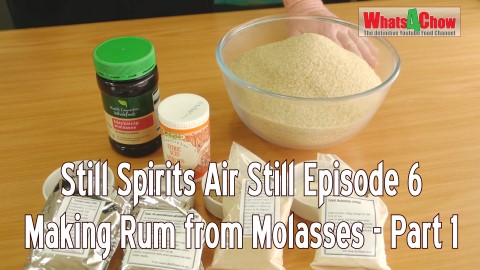
Hi and welcome back to our short series on distilling with the Still Spirits Air Still. In this episode we are going to be making rum from black strap molasses. This episode will specifically cover the ingredients required to ferment the wash, and the next episode will cover the distillation and aging of the rum.
Instructions
  1. For more details on the Still Spirits Air Still go to Brewcraft's website - https://www.brewcraft.co.za/air-still...
  2. Check out our Website http://Whats4Chow.com
  3. Please subscribe for updates and notifications!


Still Spirits Air Still – Ep. 5 – Whisky from LME Part 2 – Clearing, Distilling, Making Cuts & Aging

How to Make whiskey from LME


Still Spirits Air Still - Ep. 5 - Whisky from LME Part 2 - Clearing, Distilling, Making Cuts & Aging
Author: 
Recipe type: Distilling
 
Still Spirits Air Still - Ep. 5 - Whisky from LME Part 2 - Clearing, Distilling, Making Cuts & Aging In the second episode of our whisky from LME video, we will clear the wash, distill the wash demonstrating how to make the cuts, and then prepare the whisky for aging with charred oak. If you missed episode 1 please click here
Ingredients
  • Still Spirits Air Still has proved to be an absolute winner, and is suitable for any home distiller that wants a simple, compact system. You can check out the kit that comes complete from Brewcraft here - https://www.brewcraft.co.za/air-still...
  • Please subscribe to our channel to receive notifications and updates.


Lacto-fermented Hot Sauce – Easy Homemade Tabasco Sauce – Simple Tabasco-Style Chili Sauce

How to Make Tabasco Sauce - Lacto-Fermented Hot Sauce Recipe


Lacto-fermented Hot Sauce - Easy Homemade Tabasco Sauce - Simple Tabasco-Style Chili Sauce
Author: 
Recipe type: Sauce
Cuisine: American
 
Follow the simple video instructions to make your own amazing lacto-fermented hot sauce, similar in every respect to the all-time favorite Tabasco sauce.
Ingredients
  • 700g Chillis, stemmed and cleaned
  • 1500ml Water
  • 90ml Non-iodated salt
  • 200-300ml White wine vinegar
  • 7.5ml Sugar per 500ml sauce
  • 2.5ml-5ml Xanthan gum per 500ml sauce
Instructions
  1. Check out all of our recipes on http://Whats4Chow.com
  2. Please subscribe to our channel to receive notifications!
  3. Check out our naturally fermented apple cider vinegar: https://www.youtube.com/watch?v=veO25...


Still Spirits Air Still – Episode 4 – How to Make Whisky from Liquid Malt Extract @Whats4Chow

Still Spirits Air Stil Episode 4


Still Spirits Air Still - Episode 4 - How to Make Whisky from Liquid Malt Extract @Whats4Chow
Author: 
Recipe type: Distilling
 
In episode 4 of our series on the Still Spirits Air Still, we will taking a detour from using the Still Spirits Turbo Pure Yeast, when we make an all-grain whisky from Liquid Malt Extract. In this episode we will set up the fermentation, and this will be followed in the next episode with the clearing and distilling of the whisky.
Ingredients
  • 3kg Liquid malt extract
  • 1.2kg Sugar
  • 36g Still Spirits Whisky Yeast
  • 10g Yeast activator
  • 10g Yeast nutrient
  • ¼tsp Di-ammonium sulphate
  • 10lt Water
Instructions
  1. To view episode !: https://www.youtube.com/watch?v=fo4f9...
  2. To view episode 2: https://www.youtube.com/watch?v=HFqRN...
  3. To view episode 3: https://www.youtube.com/watch?v=zDzFm...
  4. To View Episode 5, Part 2 of LME Whisky: https://www.youtube.com/watch?v=9jUUI...
  5. A huge thanks to Brewcraft South Africa for the loan of the Still Spirits Air Still Kit --- you can check it out on their website http://brewcraft.co.za


Still Spirits Air Still – Episode 3 – Clearing & Distilling Still Spirits Turbo Pure Sugar Wash

Still Spirits - Episode 3 - Clearing & Distilling the Sugar Wash

Still Spirits Air Still – Episode 3 – Clearing & Distilling Still Spirits Turbo Pure Sugar Wash

To view episode 1 of this series: https://www.youtube.com/watch?v=fo4f9…

To view episode 2 of this series: https://www.youtube.com/watch?v=HFqRN…

In today’s episode we will clear the Still Spirits Turbo Pure Sugar Wash using the two part clearing kit supplied in the Still Spirits Air Still Kit.
Once cleared, we will proceed with distilling the wash to attain an excellent quality neutral spirit vodka, something that is normally only possible with a reflux column still.
To conclude this episode, we will do an objective taste test of the “vodka” produced using cheap wine, the same product after filtering through carbon, and the superior vodka produced from the Still Spirits Turbo Pure Yeast sugar wash.
Stay tuned for our next episode where we will be fermenting a grain based wash which will produce acetones, aldehydes and volitiles that will need to be removed from the product during the distillation run.
This will be distilled using the Still Spirits Air Still to see just how well it holds up.

You can check the Still Spirits Air Still Kit out here: https://www.brewcraft.co.za/air-still…

Please like, subscribe and share this video with your family and friends.
You can visit our website for more on distilling, food and drinks at http://whats4chow.com


#stillspirits #stillspiritsairstill #homedistilling #distillingathome #howtodistillalcohol still spirits air still,still spirits air still review,still spirits air still water distiller,still spirits air still essentials kit,still spirits air still instructions,still spirits air still video,still spirits air still starter kit,home distilling,making alcohol at home,easy home distilling,air still training,using turbo pure yeast,making a sugar wash,making a sugar wash for distilling,making sugar wash for air distiller,how to make vodka,how to

Scroll to top

Kitchen Conversions

Convert:
Masses
to:
Volumes
to:
Temperatures
to:
Lengths
to: